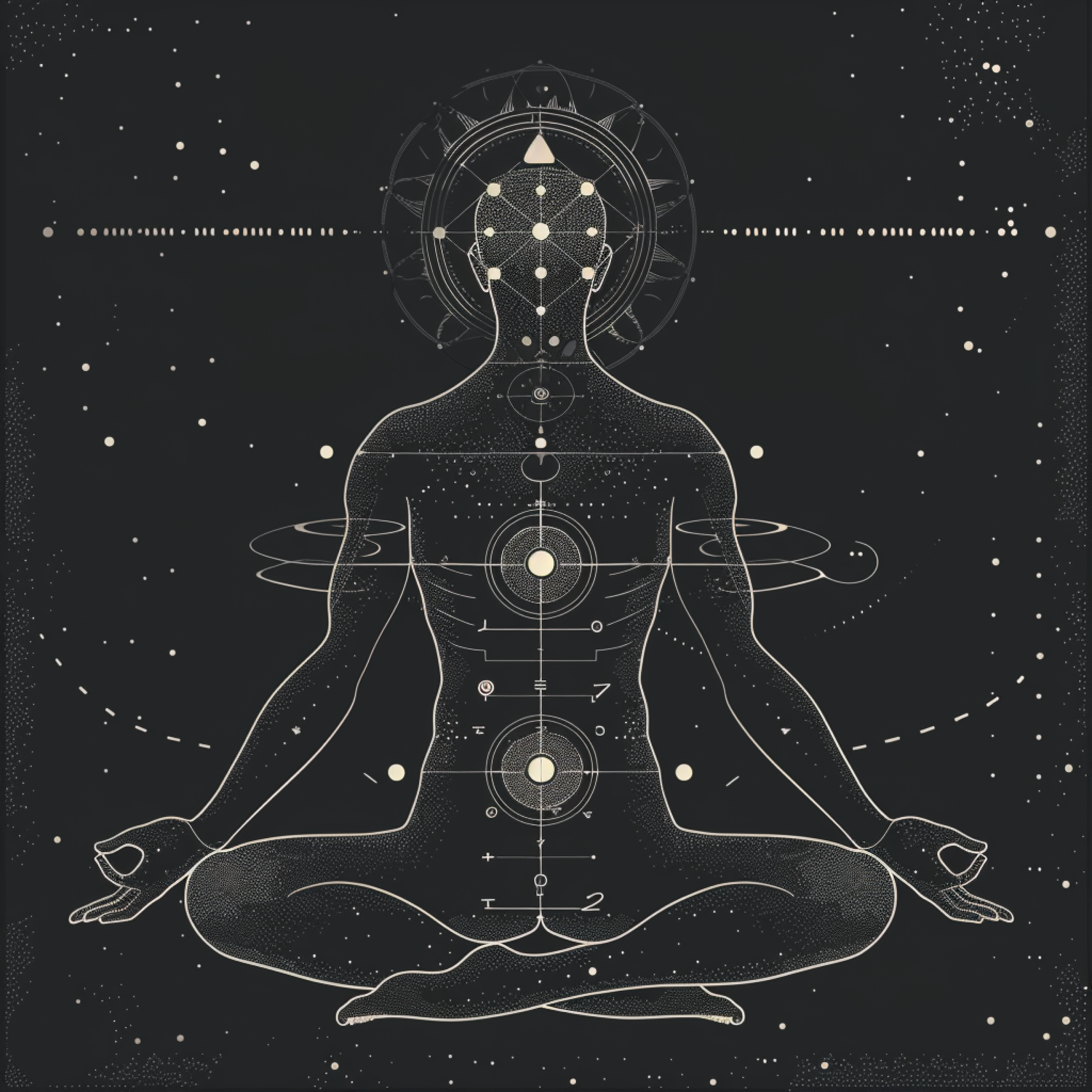
In a previous article I described a strange experience during a somatic course in Berlin: feeling fields inside my body with different densities, textures, almost tastes. At the time I had no framework for it. I called it energy, because that was the closest word I had.
Later, writing about the heart and nervous system, I learned that the heart produces the strongest electromagnetic field in the body. It is measurable a short distance away, and it is in constant exchange with the brain. Some researchers go further and suggest this field reaches other people too, though that part is far from settled.
There is a chapter between these two stories that most people have never heard, and it starts in Cold War Russia.
A glow in a Soviet darkroom
In 1939, a Soviet electrician named Semyon Kirlian placed his hand between a photographic plate and a high-voltage electrode. What developed was not just a photograph of his hand. It was a luminous, flickering discharge wrapped around it, a corona of light.
Over the following decades, Soviet researchers became fascinated by this image. They interpreted the glow as evidence of what they called the bioplasmic body, a structured field of ionized plasma surrounding and interpenetrating the physical body. It is a striking idea. Mainstream physics, though, explains the Kirlian corona more plainly, as an electrical discharge shaped by moisture and pressure at the skin, so the bioplasmic body stayed a hypothesis rather than a proven thing.
Their hypothesis went further still: that this field is not a byproduct of the body but a template for it, and that disturbances in the field show up before physical illness. Heal the field, the claim went, and the body follows. A researcher named Konstantin Korotkov later built a device, gas discharge visualization (GDV), to try to capture and measure these changes. It is a bold and appealing idea, but it has never been reliably reproduced. When others test these devices, the images track things like skin moisture, temperature, and contact pressure far more than any health signal. So it is best held as a fascinating piece of history, not as settled science.
The same territory, measured in California
Decades later, on the other side of the Iron Curtain, the HeartMath Institute began measuring the heart's electromagnetic field with modern instruments: magnetometers, electrocardiographs, EEG.
The heart's field is real and measurable, the strongest the body produces. HeartMath's research suggests it carries information and may even influence the brain activity of people nearby, though those distance effects are still debated. What is better supported is closer to home: when the heart settles into a smooth, ordered rhythm, sometimes called coherence and tracked through heart rate variability, people tend to report sharper focus, steadier emotions, and a calmer response to stress.
Neither tradition knew of the other. One was photographing a glow around living bodies in Soviet institutes. The other was measuring electromagnetic signals from the human heart in California. Same territory, in a sense. Different instruments, different language, different political world. It is a striking parallel, even if it proves nothing on its own.
What if the field is how we listen?
Here is what catches me. Every system in this story, Kirlian photography, GDV, HeartMath's HRV, treats the body's field as something emitted: a signal radiating outward, something to be photographed or detected from outside.
But what if the field is mostly how the body listens?
Think back to the Berlin experience. I was not radiating something. I was receiving, feeling density differences in the space around me. My nervous system was acting as an instrument of detection, not a broadcast tower.
That reframes coherence for me. A coherent heart may not just emit a stronger field. It may work as a more precise antenna for the fields around it. In that light, the body's field is less a health signature and more a possible organ of perception, quietly sampling its surroundings. I want to be clear that this is my own speculation, not a finding. But it is the question I keep returning to: not only what am I feeling, but what is happening in the field between me and everything else?
If there is anything to it, then practices that cultivate coherence, meditation, breathwork, qigong, even simply feeling appreciation, would not only steady your inner state. They might sharpen how you read the world around you, below the level of conscious thought.
Birds that navigate by magnetic fields do not just passively receive them, they come into a kind of resonance with them. Maybe heart coherence is a human echo of that. Not a health metric, but a way of tuning.
The Soviet scientists photographed the antenna. HeartMath measured its signal strength. The question neither quite asked was what it might be tuned to.
The body is not only physical. It seems to have a field dimension. And that field, the more I sit with it, feels less like a broadcast tower and more like a conversation.
Read more
Where the threads of this story come from, the solid science and the contested claims marked as such:
- Image Modulation in Corona Discharge Photography, Pehek, Kyler and Faust, Science (1976). The classic study showing Kirlian images mostly track skin moisture, not a life field.
- A systematic review of Gas Discharge Visualization imaging (2023), which concludes that Korotkov's GDV method is not yet clinically validated.
- How Do You Feel? by A.D. Craig (2014), the neuroscience of interoception, the body's sense of its own inner state, which sits underneath the idea of the body as a receiver.
- Long-distance navigation and magnetoreception in migratory animals, Henrik Mouritsen, Nature (2018), on how birds actually sense magnetic fields.
- The "energetic heart", from the HeartMath Institute. They are the source of the claim that the heart's field connects people, which remains debated.